 Hello! My job as customer experience manager is to cover several aspects related to the image and positioning of the company, whether in terms of communication, marketing, but also and especially with regard to the design and ergonomics of our software platform.
My role is therefore to ensure that the overall experience of people using TKM is consistent and seamless, from the first interaction to the use of our platform and services. This also includes the onboarding and training of new employees who regularly join us.
My goal is therefore to support each person throughout our shared journey and to ensure that all our actions are aligned with our values, including our commitment to more responsible and sustainable innovation.
You are also a "Champion for the Planet" at TKM. How did that come about?
[Laughs] As an anecdote, during my job interview, Christophe Lecante, the president of TKM, asked me about the “Art Projects” section of my portfolio.
He seemed genuinely curious about these various activist and artistic projects, so I thought, "Okay, I'll give it my all," and I presented him with projects combining ecology and feminism, or even a poster for the anti-capitalist contingent of the Grenoble Climate March. This commitment, which some might perceive as a bit "radical," became a running joke between us.
But it was also on this occasion that we were able to share our desire to address the challenges of corporate responsibility, and in particular that of SMEs, in order to initiate an irreversible shift.
Is it from this curiosity and this common interest that TKM's responsible approach was born?
The TKM movement had already been initiated by Christophe. I think it stemmed from a feeling of being caught between a sense of urgency on the one hand and a feeling of powerlessness on the other. Having started this movement, I was obviously very quick to join. In March 2023, we seized the opportunity presented by the launch of the Business Climate Convention.
Moving forward collectively, with companies of all sizes and from all sectors on such complex paths, was a real opportunity that we wanted to seize and the decision was made in a few minutes.
Companies' participation in the CEC is based on a partnership between the CEO and the person in charge of CSR issues, known as the " Planet Champion ." At TKM, we prefer the term " champion for the planet "... and that's me!
 The Business Convention for Climate (CEC) is a French initiative that brings together companies from different sectors to help them integrate social and environmental issues into their strategy. Over a period of several months, participants benefit from training, collaborative workshops, and conferences with experts, with the aim of defining a concrete roadmap towards becoming a regenerative business.
What do you mean by "making these issues accessible in decision-making"?
We are neither influencers nor a consulting firm! However, we are aware of our capacity for impact since we provide a monitoring and analysis platform that is used to help make strategic decisions.
We believe that our role will increasingly be to offer tools that facilitate technological choices while integrating environmental issues, resilience and respect for all components of our living ecosystems into this decision-making process.
To achieve this, we aim to develop solutions that will allow our clients, among other things, toassess the ecological impact of their innovations and technical choices (such as, for example, the choice of a material).
We therefore wish to be able to open up new perspectives and to participate in raising awareness among all those involved in R&D and innovation processes.
This could take the form of a tool that would allow us to visualize in advance the impacts of an innovation or the resources needed for its implementation.
Our ambition is to broaden the horizon of possibilities and enable or encourage more responsible choices.
Can you detail the other aspects of your commitments?
Of course! The easiest course of action to initiate was internal and consisted of minimizing the environmental impact of our own operations.
First, we carried out our first carbon footprint assessment (scopes 1, 2 and 3). This will serve as a reference for measuring our progress in the coming years and will be regularly updated.
Regarding the choice of computer equipment, we opted for a partnership with Commown , a cooperative that offers eco-designed computer equipment for rent within the framework of a circular economy .
Let's be clear: this choice costs us significantly more than buying new. But it allows us to be consistent with our ambitions and values, because this approach is more sustainable ; it reduces our dependence on an extractive model while promoting new, collaborative, and transparent narratives, particularly internally.
In parallel, we have implemented a series of internal training programs for all current and new employees of TKM. Each new recruit participates in a half-day session dedicated to the knowledge we have gained from the Business Climate Convention. Furthermore, we are gradually enabling TKM teams to participate in the onboarding days offered twice a year by the CEC Alpes et Bassin Lyonnais (French Climate Change Conference of the Alps and Lyon Basin).
We have also integrated the Climate Fresk into our training and onboarding process. This allows everyone to better understand the interactions between human activities and climate change and to consider solutions in their daily lives, both professional and personal.
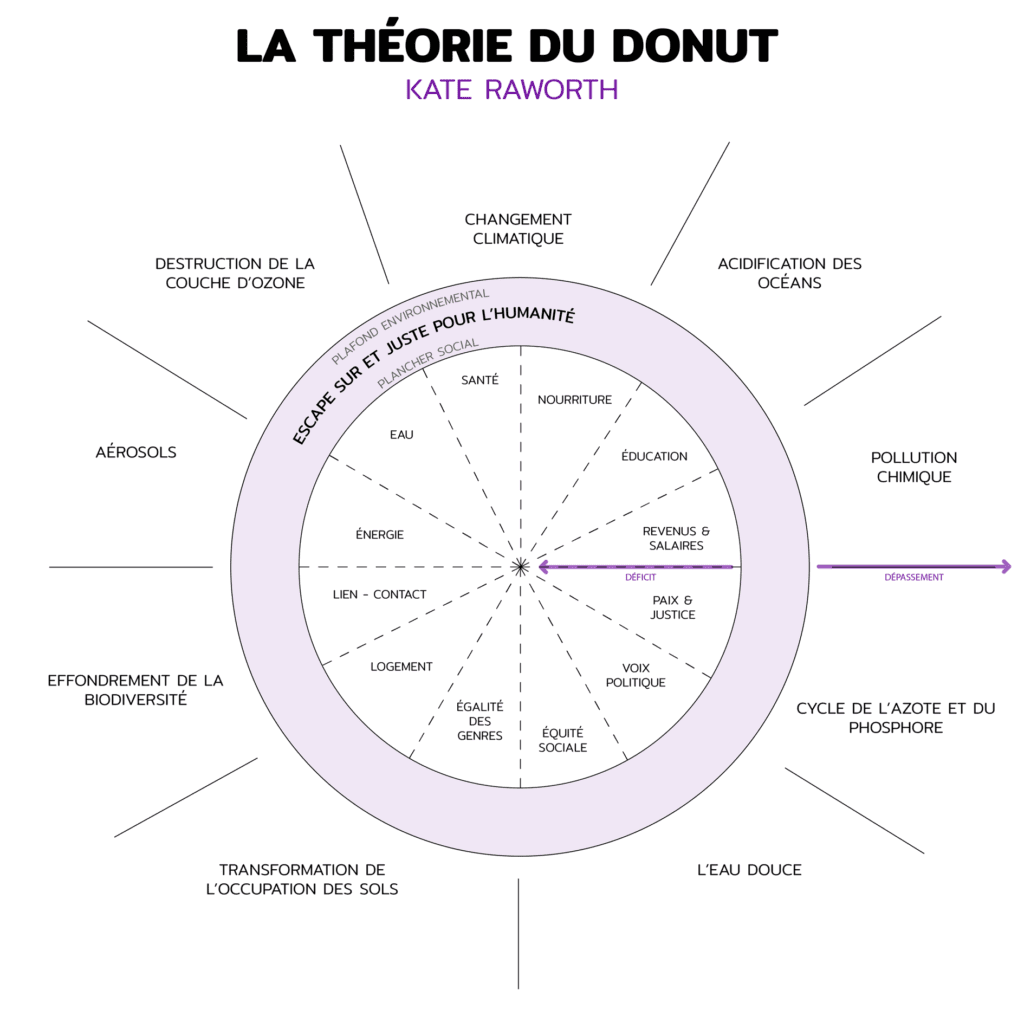
We regularly try to share information on these kinds of topics, which can contribute to raising awareness. In one of our recent internal newsletters, for example, we presented (or reminded readers of) Doughnut Economics , a model in the form of a doughnut that highlights the tension between essential human needs and an ecological ceiling that corresponds to planetary boundaries.
Finally, on a more practical level, we strive to regulate and manage the temperature of our premises responsibly. This ranges from limiting heating in winter and air conditioning in summer, to purchasing temperature-regulating blinds or fleece blankets made from recycled fabrics for our teams, etc.
Does this change anything for your customers?
It's still a bit early to talk about the impact on our clients, as environmental awareness in the industrial world is progressing in line with the specific sectors of activity. Some companies are already aware of these issues and see our approach as a real opportunity to integrate these concerns into their R&D strategy. Others, however, are still focused on short-term economic survival and therefore far removed from these topics.
But one day or another these subjects will come together, because technological innovation will have to enable companies, and before long, to increase their economic and geostrategic resilience.
However, we are very careful about how we communicate our commitment. We prefer to take concrete action, implementing tangible initiatives before communicating. We believe it is essential to proceed step by step, with rigor and honesty, rather than rushing ahead and promising more than we can deliver.
What measures are you putting in place in terms of positive impact?
We are aware of the limitations inherent in our activity. Another of our objectives is to go beyond simply reducing environmental impacts. We are considering ways to have a positive impact on living things in general, that is, both human and non-human life.
For example, we support the Pays Voironnais football club because it has an ambitious project for the children and young people of the area where TKM was founded 20 years ago.
Another initiative we participated in was financing the takeover of theVergers d'Hysope orchard in Veyrins Thuellin by a young entrepreneur. This is a local initiative for organic farming that operates through direct and local sales, AMAP (Community-Supported Agriculture) programs, and integrates respect for local biodiversity in the plantings, land management, and the entire orchard.
We also support associations like Sylv'ACCTES, whose guiding principle is the preservation of the forest heritage of the territories.
However, we do not wish to limit these actions to financial contributions. We would like to be able to establish ourselves in other ways of helping and supporting, within a more sustainable, more engaging for the TKM team, particularly in our way of being in the world.
This work is ongoing, and we are constantly seeking to refine our approach to generating impacts that go beyond simple financial compensation. Ultimately, it seems essential to reflect on our collective imagination : we would like to envision solutions that do not yet exist to problems that are often perceived as intractable.
This actually fits quite well with the DNA and history of TKM which, 20 years ago, invented a profession that didn't exist...!
What are the major challenges you face in implementing this sustainable commitment?
The main challenge is walkinga fine line : between our awareness and desire for change on the one hand, and the connection with the needs expressed by our clients on the other. Unfortunately, this is often contradictory.
Combining this ambition with economic reality is a daily challenge for an innovative company like TKM. Where to start? How to move forward based on convictions and intuitions without getting bogged down in misleading certainties? How to manage this innovation in an agile and responsive manner?
These are questions that may seem philosophical, but they are also very concrete. We are convinced that these investments and efforts will bear fruit, and we will proceed as TKM has always done: by co-developing its new solutions with its customers.
Approximately 80% of the innovations brought to TKM's tools and services each year result from this collaborative approach with our clients of all sizes and sectors. For responsible innovation, perhaps even more so than for other areas, co-creation and collective intelligence seem to us to be the cornerstones of useful and sustainable solutions. These solutions will combine our clients' expertise in their respective fields with TKM's expertise in leveraging scientific literature.
Finally, there are the human and organizational challenges. Integrating a corporate culture centered on subjects such as respect for all living beings, on collective mechanisms for subsistence, and no longer viewing growth as infinite when we know we are operating on a planet with finite resources…
All of this requires strong mobilization and commitment from everyone on the team. We have initiated several collaborative workshops to discuss these topics with our colleagues and gather their ideas and suggestions on how we could improve.
We believe this co-construction process is essential to ensure everyone's involvement, but also to bring forth fair and varied ideas and actions.