In this context, proactive monitoring should ideally allow us to perceive what others are not yet seeing. But how can we distinguish, within the ever-increasing mass of information, the faint signal heralding a significant change?
By adopting the right methodology and equipping yourself with the right tools. Explanation.
SIGNAUX FAIBLES : DÉFINITION
A weak signal is a piece of information of low intensity, or a deduction from an isolated fact or partial information, which, once amplified, can fuel strategic forward thinking aimed at anticipating a crisis or its impacts on the company.
It allows us to anticipate an event (or a series of events) well before its occurrence becomes clearly evident to all observers.
Un signal faible peut passer dans les mailles d’un système de veille interne sans que sa valeur stratégique ne soit décelée. Il arrive parfois au cours d’un RETEX qu’on se rende compte a posteriori que nous avions eu entre les mains tous les signes annonciateurs (et de faible intensité) laissant présager du lancement par un concurrent d’un produit très innovant ou très impactant.
The weak signal is indeed potentially a carrier of key information whose highly strategic nature may not be obvious at this stage to a majority of employees who will have this information in their hands.
Thus, a weak signal refers to:
- This information will not be of strategic value to 99% of the population
- Mais qui aura un impact sur un business / une filière / un domaine technologique
Bon à savoir : La paternité de la notion de signal faible peut être attribuée à Igor Ansoff dans les années 70 et repris puis amplifié en France par le professeur Humbert Lesca, Professeur Émérite à l’université de Grenoble, dans le cadre de ses travaux sur la Veille anticipative stratégique (VAS).
Weak signals: two examples
In 2014, the whole world discovered the Apple Watch!
Quelle surprise ? Sans doute pas pour un observateur averti, qui avait eu le loisir dès le début des années 2000 d’observer l’intérêt croissant du géant américain pour les « wearables technologies », illustré par quelques acquisitions puis par le dépôt de plusieurs brevets spécifiques à des « wearable electronic devices » dès 2011.
Comme l’illustre cet exemple, c’est la rencontre de plusieurs informations distinctes et parcellaires qui peut faire naître une intuition, un début de réflexion pour l’analyste. A ce stade, on peut encore évidemment se tromper et voir du sens là où il n’y en a peut-être pas.
Another example: the emergence of virtual reality.
In an analysis conducted in 2015, TKM traced the emergence of virtual reality and its industrial applications, analyzing scientific publications conducted by hundreds of researchers worldwide over the previous 20 years.
Les différentes « briques » qui participent de la réalité virtuelle font l’objet, au début de la période, de travaux de recherche totalement indépendants. Puis de plus en plus de projets ont commencé à s’intéresser aux connexions entre ces domaines (Capture vidéo, géolocalisation, Puissance de calcul, Maquettes numériques…). Ces connexions se sont intensifiées pour donner lieu dès l’an 2000 à l’émergence de la réalité virtuelle comme domaine à part entière, dont tout le monde connait l’essor ensuite.
Un observateur attentif à l’évolution des contenus de ces publications scientifiques pouvait ainsi raisonnablement disposer d’un temps d’avance et d’anticipation appréciable par rapport à ses concurrents.
Ces exemples illustrent un point important : la détection d’un signal faible en soit ne suffit pas. Elle doit être investiguée, validée et vérifiée. Il faut pouvoir trouver d’autres signaux qui permettront de transformer le cas échéant ce signal faible en signal clair.
➡️ Participer à notre webinaire “Comment détecter et exploiter les signaux faibles ?
POURQUOI EST-IL ESSENTIEL DE SE PRÉOCCUPER DES SIGNAUX FAIBLES ?
Un break-through technologique peut aussi constituer un signal faible qui va nourrir utilement une stratégie d’innovation volontariste. Par exemple, le fait qu’il soit désormais possible de greffer des micro-LED sur du textile de manière industrielle peut donner l’intuition à un chargé de R&D dans l’aménagement automobile qu’il y a quelque chose d’innovant à inventer.
Aussi, un même signal faible peut être le révélateur de :
- Une opportunité: en vous saisissant rapidement du signal faible, vous pouvez être parmi les premiers à vous emparer de la nouvelle application qui en découle.
- Une menace: ce même signal faible peut être annonciateur de l’arrivée de nouveaux entrants sur un marché donné.
Quoi qu’il en soit, pour éviter de se faire « ubériser » par des concurrents plus innovants, il est essentiel de se donner les moyens d’identifier à temps les signaux faibles, pour décider ensuite de ce que l’on souhaite en faire.
➡️ Lire aussi – Veille stratégique : comment détecter à temps opportunités et menaces ?
HOW TO AVOID MISSING A WEAK SIGNAL DURING MONITORING WORK?
Par définition, un signal faible peut venir d’horizons extrêmement variés. Il peut remonter à l’occasion d’une veille très pointue sur un sujet bien précis, émaner des résultats d’un groupe de travail sur l’évolution d’une norme, ressortir d’un brevet concurrent ou encore provenir d’un univers technique, industriel ou économique très éloigné du sien. Un signal faible peut ainsi être détecté aussi bien dans son champ quotidien que provenir d’un univers complètement décorrélé. Et c’est là toute la complexité de l’exercice !
Il convient donc de ne pas limiter sa veille à son cœur de métier, mais bien de garder un œil sur : la veille concurrentielle indirecte, les Mega trends, la veille start-up, la veille réglementaire, la veille financière, etc…
In the field of innovation, patent databases and scientific publications – obviously – but also collaborative projects, theses, web articles… are essential sources for a technological and scientific monitoring worthy of the name.
Or, dans le contexte d’infobésité actuelle, la recherche d’un signal faible peut vite s’apparenter à la recherche d’une aiguille dans une énorme botte de foin !
To avoid losing your monitoring unit in the maze of irrelevant information, it is important to equip it with the appropriate monitoring tools.
TKM PLATFORM : A GAME-CHANGING MULTI-SOURCE MONITORING TOOL
L’intuition humaine est clé dans le processus d’identification d’un signal faible. Une IA générique ne suffira pas à donner du sens à des informations isolées, comme peut le faire un humain. En revanche, l’IA peut grandement aider à synthétiser et à construire rapidement un début d’intelligence sur un domaine donné et ainsi permettre de surveiller des champs éloignés.
It is in this state of mind that the TKM software platform was designed.
Grâce à ses mécanismes de recherche et de synthèse des informations, ces outils permettent aux analystes de réduire le temps passé à analyser la masse d’informations existantes, tout en permettant le phénomène de dé-fixation.
In other words, thanks to our platform, companies can break out of their dominant thinking patterns and explore areas that were previously unfamiliar but potentially carry weak signals and are sources of interesting opportunities!
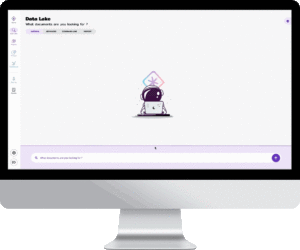
With TKM Platform, it becomes possible to monitor all possible areas
without dedicating all your time to it.
Want to learn more about how it works?