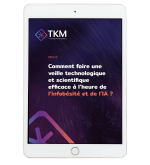
White paper
Rethinking technology monitoring in the era of AI
An exclusive white paper to evolve your practices and (re)position monitoring at the service of your strategic decisions.
 Innovation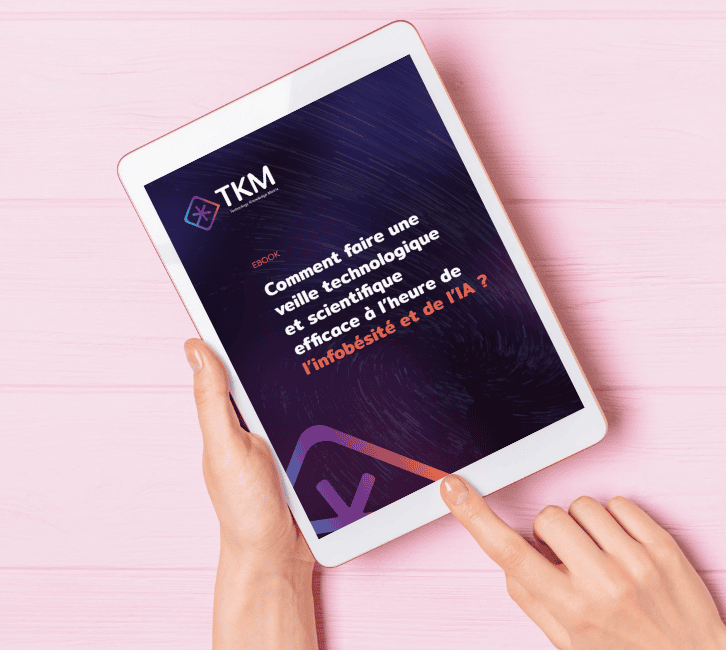
Do you have an effective technology monitoring system?
Or do you know how to optimize it?
Pour le savoir, prenez 30 minutes pour lire ce livre blanc !
Pas de recette magique, mais des pistes concrètes de réflexion pour vous aider à redéfinir les bases, améliorer l’utilité et l’efficience de vos dépenses de veille.
Et définir de nouvelles ambitions pour votre veille et l’intégrer pleinement à vos processus de décision.
Why this white paper?
Faced with the explosion of data, cross-functionality and the acceleration of innovation cycles and increased competitive pressure, your monitoring systems must evolve.
Whether they are one-off or continuous, your processes must enable you to meet all these new challenges that R&D and Innovation activities face.
To help you with this, TKM has condensed 20 years of field experience into this white paper: concrete feedback, proven methods, key tools and good practices to adopt to move from passive monitoring to a real strategic management tool.
☑️ Un guide complet, précis et opérationnel.
☑️ Écrit par des experts de la veille technologique et IA.
☑️ Pour les entreprises innovantes de toutes tailles, tous secteurs.

Veille technologique : trop d’informations.
Peu d’impact.
Newsletters are being read less and less, collection tools are overwhelmed by the volume of information, and internal clients are making increased demands…
However, in an increasingly unstable and uncertain world, the ability of management teams to capture weak signals is becoming more than ever the condition for the survival and growth of companies.
Useful data is accumulating, but decisions cannot wait.
➡️ Vos équipes de veille passent plus de temps à trier qu’à analyser ?
➡️ Vos veilles ne sont plus vraiment lues ?
➡️ Vos crawlers capturent de monceaux de données, mais vous manquez d’insights stratégiques ?
➡️ Vous achetez pleins d’études plus ou moins utiles, alors que vous devriez avoir déjà tout sous la main ?
Rest assured… your case is normal!
It's not just a question of tools, but also of methods and requirements: having the strategic information you need internally.
What you will discover
This white paper proposes a clear methodological approach to:
Rethinking your monitoring system in a context of information overload.
To restore meaning to collection, analysis and dissemination.
Intelligently integrate AI to generate real productivity gains.
Moving from information flow management to a strategic management system.
This white paper is neither a tutorial nor a technological manifesto.
He shares a structured, operational vision, nurtured by 20 years of experience working with innovative companies.
Frequently Asked Questions
I already have a monitoring system and tools in place. Can this white paper be useful to me?
Yes. It's aimed at organizations that already conduct competitive intelligence, but whose results could be improved. It will help you take a step back, identify pain points, and activate new levers.
Is this marketing content or a genuine in-depth resource?
It's dense, structured content designed to be useful. It's not a sales brochure about TKM's solutions. It's based on 20 years of experience and R&D dedicated to technological monitoring.
How long should I allow to read it?
Allow 30 to 40 minutes. It's a deliberately long format, but clear, well-paced and easy to read.
Is it necessary to have a technical profile to benefit from it?
No! This white paper is primarily aimed at R&D, innovation, and intellectual property departments. It is demanding in its content, but accessible to all professional profiles.
Does it contain methods that can be applied in practice?
Yes. The document offers a comprehensive and pragmatic approach, directly applicable to structuring your monitoring, intelligently integrating the contributions of AI technologies, that is to say, distinguishing the situations where they can be useful from those where simpler and more economical solutions are still largely sufficient.