Access to technological and scientific information has never been so widespread. Patent databases, publications, specialized websites, signals from startups or collaborative projects… the tools are plentiful. Yet, many organizations still struggle to structure a usable intelligence system aligned with their strategic priorities.
Why? Because easy access to sources is no substitute for a rigorous methodology. And that's often where the problem lies.
Gathering information does not constitute a monitoring plan
The confusion between collection, curation, analysis, and dissemination remains common. The result: monitoring systems that generate volume but little impact. Too many teams spend more time filtering than analyzing. Too many decisions are made without real strategic insight.
Formalizing a monitoring plan is precisely what allows us to overcome this observation: by structuring the objectives, roles, sources and deliverables, you restore readability, efficiency and value to your monitoring efforts.
A simple method to structure your practices
At TKM, we have been supporting innovation, strategy, R&D, and IP departments for over 20 years in setting up customized monitoring systems. What we consistently observe is that without a clear framework, even the best tools are underutilized.
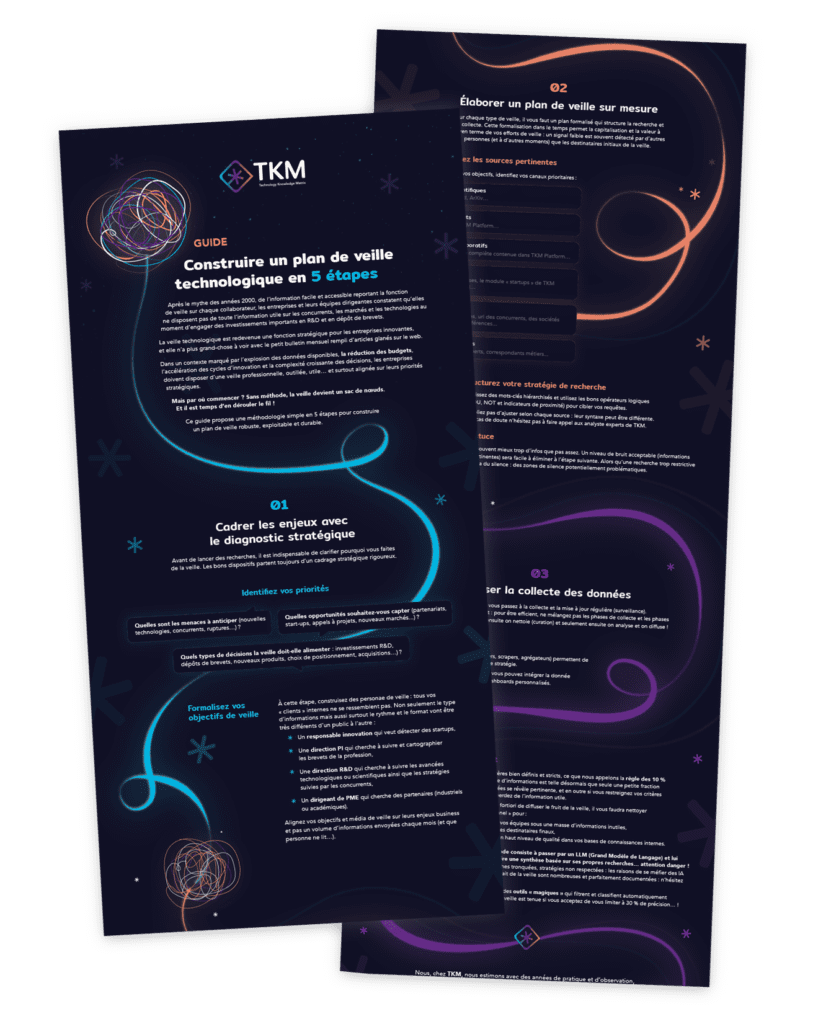
It is with this in mind that we have designed a concise methodological guide: "Building a technology watch plan in 5 steps".
This document offers a structured approach to moving from fragmented information collection to a managed, analyzed, and capitalizable intelligence system. You will find:
- the main steps of an effective monitoring plan,
- concrete advice to adapt your practices to your challenges,
- suggestions for industrializing data collection and strengthening analysis,
- a framework for aligning your teams and deliverables.
A guide designed for R&D, innovation, strategy and IP functions
This content is aimed at all functions in charge of anticipation and monitoring within the company: innovation managers, scientific departments, strategy or industrial property, project teams, analysts or monitoring officers.
It offers a framework that can be activated directly to structure (or redesign) your practices without complicating your internal processes.
Download our Guide!
Building a technology watch plan in 5 steps
Competitive intelligence can no longer be limited to occasional reports or manual data collection. Faced with the explosion of data, the acceleration of innovation cycles, and the increasing complexity of decisions, companies need a structured, targeted, and truly usable system.
Because without a method, monitoring becomes a tangled mess, this mini-guide helps you unravel the thread with a simple, structured and actionable approach:
→ Clarify your objectives and priorities,
→ Build a monitoring plan aligned with your strategy,
→ Equip your teams and capitalize on your data,
→ Transform monitoring into a decision lever for your R&D and innovation projects.