
To maintain the competitive advantage a company hopes to gain, it still needs to think about protecting its innovations.
In this context, what role does industrial property play?
In particular, is a patent a sufficient protection measure?
How can you make the best use of this tool and plan this strategy for the long term?
Let’s break it down.
INDUSTRIAL PROPERTY: DEFINITION AND CHALLENGES
Industrial property aims to protect and add value to industrial and commercial inventions, innovations and creations. With this in mind, it notably encompasses:
- Invention patents;
- Utility certificates;
- Trademarks;
- Industrial designs and models;
- Geographical indications protecting industrial and craft products.
In France, the INPI (French National Institute of Industrial Property) is the authority responsible for protecting industrial-property rights. It is therefore the body with which title applications should primarily be filed.
Industrial property aims to provide you with legal protection when you are the originator of an inventive creation and wish to keep a monopoly on exploiting it for 20 years, which is exactly the point of a patent. Indeed, without this legal tool, your competitors would be entitled to reuse and commercialize your invention.
Industrial property is therefore a key tool for your competitiveness if you are an innovative player in your market. Founders of tech start-ups preparing to raise funds know this well. They will need to provide solid proof of the barriers to entry they will be able to create against bigger, already-established competitors.
The 3 criteria a patent must meet to be accepted
Be novel:
No trace of prior art relating to the claimed invention should be found. No one (including you) should have publicly spoken about what you wish to patent.
Be inventive:
The claimed invention must not be obvious to a person skilled in the art, as the saying goes. In other words, you cannot file a patent on an obvious process available to everyone, for example “filling a glass with water.”
Have an industrial application:
It is impossible to claim a common good or a natural effect that does not result from inventive or ingenious human work. The subject of the invention must claim a technical effect.
INDUSTRIAL PROPERTY: DO YOU ABSOLUTELY HAVE TO FILE A PATENT?
When developing a new technology, filing a patent can therefore truly prove essential. But there are also situations in which it will be useful NOT to file a patent!
Filing a patent is like taking antibiotics: it’s not automatic!
Filing a patent will be worthwhile if it:
- lets you generate a real advantage over your competitors,
- or contributes favorably to your company’s image or increases your chances of securing funding (PIA, fundraising, accelerators, R&D tax credits…).
But conversely, you will probably be better off protecting yourself in another way (and in particular preserving your future freedom to operate) if, for example:
- Proving infringement will be difficult (reverse engineering)
- Your claims are very specific and could easily be worked around (by changing an ingredient or the proportions and composition of a recipe)
- Innovation cycles are so fast that obsolescence will catch up with the invention before the end of the patent application’s examination cycle
- Or when you think it is actually in your interest to offer standards to the market by leaving the technology royalty-free
AND ONCE THE PATENT IS FILED?
Filing your patent application is not the end of the journey. For this investment to be genuinely useful, you will now need to (even more so) monitor your competitors’ patent filings!
Why?
This monitoring serves several purposes:
- Making sure over time that the expenses you continue to incur (geographic extensions, annual maintenance of rights) remain justified and useful. Conversely, continuing to maintain an obsolete patent, or one that has been worked around a hundred times, no longer serves any purpose.
- Watching for potential infringers: monitoring your competitors and their future filings, and if necessary intervening with the patent office when it is about to grant a favorable decision on a disputed competing patent. You could always challenge it later before the relevant courts, but this will be more costly and also riskier.
- Weakening competing patent applications: keeping track of the competition is a good way to block the grant of a patent that could prove troublesome for your company. Indeed, once a pending patent application is published (after the initial 18-month secrecy period), you have a few months to show the examiner’s office that it does not comply, for example due to a lack of inventive step, or on the grounds of prior art from another document already in the public domain before the filing date of the patent in question.
Hence the importance of always keeping an eye on patent applications filed in your sector… but also of broadening your monitoring to scientific publications and conferences.
Read also: Prior-Art and Patent Research: The Guide
So, monitoring your competitors’ patent activity helps protect your innovations, manage your own patent portfolio effectively, and will also let you detect and pursue potential infringers, or block, very early on, applications from your competitors that could prove troublesome for you.
INDUSTRIAL PROPERTY: HOW DO YOU MONITOR ALL NEW PATENT APPLICATIONS?
In certain sectors, as many as 1,000 to 1,500 new patent applications can be published worldwide every month.
However, from experience, only 10 to 15% may prove worth monitoring.
Given such a volume of data to process, and given the strategic nature of this task, this activity can take up a person’s time for as much as 4 to 5 days per month. Not only time-consuming, this task is, understandably, often experienced as tedious and unrewarding for monitoring and analysis teams. Fortunately, there are Machine Learning tools that make it possible to carry out this work quickly and efficiently…
Read also: State of the Art: How Can You Relieve Your Teams of a Long, Laborious Yet Strategic Task?
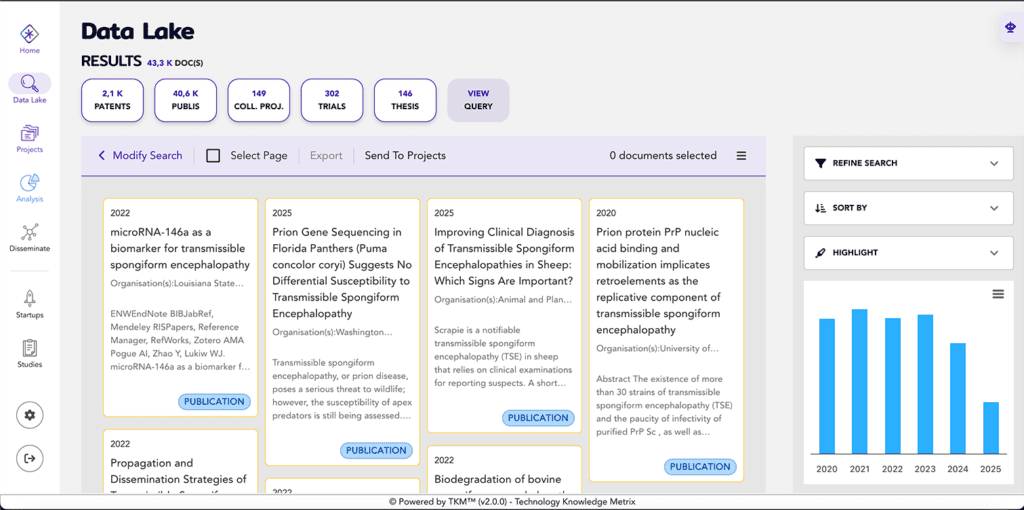
Designed to facilitate and speed up the analysis of heterogeneous data, the software platform developed by TKM makes it possible to automate this patent monitoring. Combined with our team’s expertise, it provides a global, 360° view of a given universe and enables fast, relevant multi-source data research and analysis.
Detecting troublesome patents, mapping competing patents, identifying infringers, building a map of your strategic environment and your research-and-innovation ecosystem…
Thanks to TKM Platform, you are able to best protect your innovations by carrying out targeted competitive intelligence monitoring and spending no more than 10 minutes a month on the tedious tasks this activity inevitably brings.
Would you like to find out more about what our tools offer?